Viser opslag med etiketten mixer. Vis alle opslag

lørdag den 4. februar 2017

DIY Modular #2: Nixie tubes for VU meters.

I want to give you a brief insight in the progress I am making on my wooden modular project.
I've already shown you the CRT-module(s) as visual feedback. I want to have a 4-channel summing mixer for all the the different outputs from the various modules and I thought it would be nice to have a VU meter for each channel to be able to monitor signal activity - and why not have nixie 'magic eye' tubes for just that!


The outputs from each channel is going to be sent to the main stereo output module through pan pots to create a stereo field. The main output module has two 100mm faders for left and right channel and for visual feedback two IN-13 nixie VU meter tubes are installed.

The technical aspects and circuit details of the modules will be covered further when I am done connecting it all. Below is a video of all the tubes (CRTs included) running together for the first time. The input signal is Boards of Canada's "Davyan Cowboy" :]




fredag den 23. maj 2014

Aristoteles Logic Synth Update #1: MIXER

Oh what a spring it's been! I was bedridden for about a month which really zapped all my creativity and I've slowly recovered now to bring back my mind on what is the icing on my cake of life: electronic gadgeting.

So just around New Years Eve I posted a picture of my newly assembled modular synth casing - no intestines yet though! But just before my bed claimed me for a minor lifetime, I was able to finish up the first and central part of the system: the 8-channel mixer with simple BP/LP filters + power supply.

Here's a demonstration of what I am talking about:


So the idea is that you have 8 channels in the mixer which are summed together after they've passed the filter circuit and the respective volume knob. When using stackable banana-jacks one might ask why bother with a multi-channel mixer; why not just stack 'em on top of each other and using passive resistor/diode mixing?
The problem for me was that mixing with just resistors would cause each output from every oscillator to drop in voltage and maybe cause instability with edge-detection in the chips they would enter - and diodes make distinctive modulation when used for summing. Which is why every output enters a diode, so it's still possible to mix signals together in a single mixer channel if one is running low on free channels. Other than that, diodes make sure that no cross-talk occurs if stacked for multiple operations.


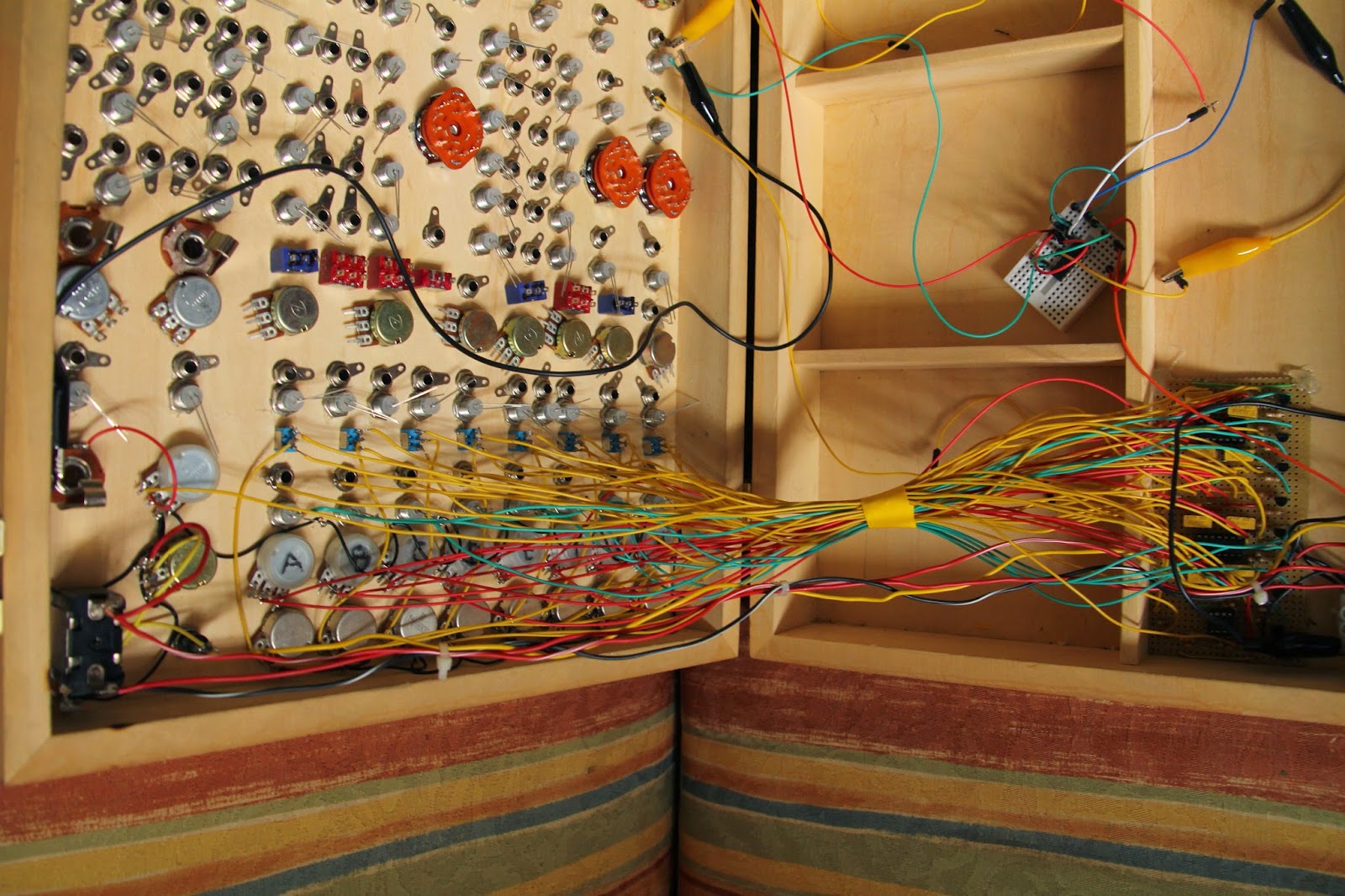
Some pics:


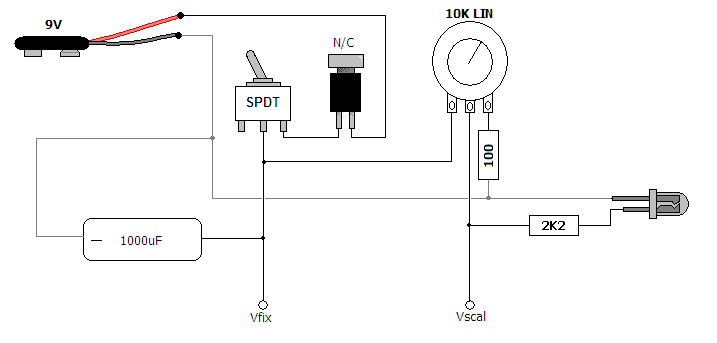
The power supply was super simple, just a power switch and momentary N/C button to switch on  and off and discharge the 470uF cap to get the power starve effect. Starving only affects the CMOS-chips used for sound generation, the mixer circuit isn't affacted by the variable supply voltage.
I will discuss the other modules in future entries and here's some schemes for the willing.