onsdag den 13. maj 2015

Debut album released on DIY audio player

For my bachelor-degree project I decided to pile together various recordings and compostions collected during the past years I've been under my alias Dögenigt and make an album.

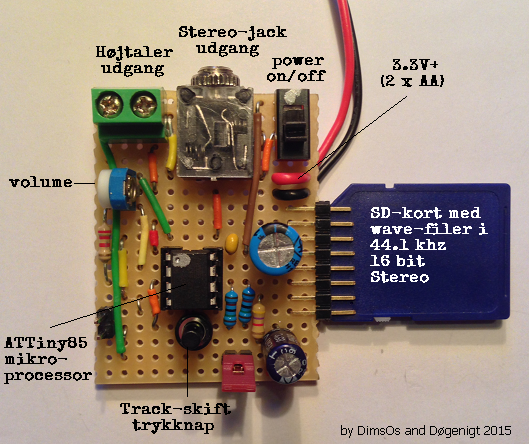
For a long time I'd been thinking of an alternative to the digital release or vinyl and what have you and I discovered a tiny circuit based on a miniature arduino-like chip (ATtiny85) which can be programmed to read lossless quality sound files from an SD-card and play them (in 44.1 kHz 16 bit) via the PWM pins.
So I decided to go ahead and build the circuit into a small audio player to be built into some casing as my album and have the project and journal revolve around that.

I've been working on the project for the past couple of weeks - it's all in the papers I wrote.
Link to the paper in danish: http://data.xn--dgenigt-q1a.dk/DIEM/opgaver/BA3-Bachelorprojekt.pdf
I tried to translate into english but failed to do so. Let me know if you have success!

Images from the project:

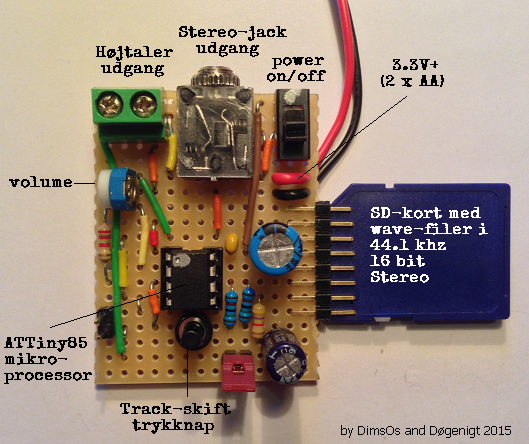
Wave-player based on ChaN's circuit and code:
Runs of 3.3V and outputs sound directly to jack output in 44.1 kHz 16-bit sound. So far, only mono as more digital pins are needed. The PWM-outputs on the ATtiny85 each create an 8-bit signal, when 2 are added together they make 16-bit. For stereo 16-bit sound 4 digital pins are needed. We didn't have enough time to do this but I know of a guy who did it with an ATmega328.

    Finalized player with batterypack, speaker and SD-card.
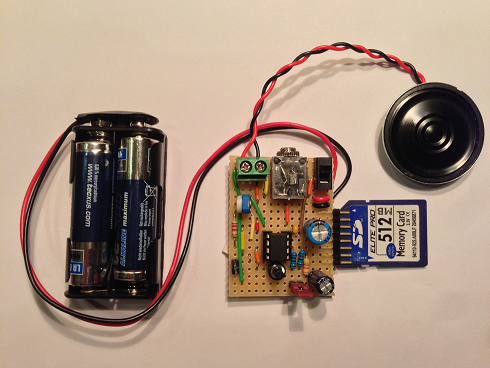
 
    Simple version of the player with no jack output but screw terminals instead for power and output.

    Player cased inside VHS-cassette :-)
    ChaN's (simple!) circuit


The album is already online on my bandcamp as digital download but in the future I will have the release available on this platform as in the pictures above. The whole album can be bought for $10 and of course streamed for free. All the tracks are made with my homemade gear. Enjoy!

mandag den 6. april 2015

Composing music on the Gameboy with LSDJ

I've been busy with my undergraduate project on the conservatory but I've been spending my time fiddling with the LSDJ (Little Sound DJ) for Gameboy Classic / DMG - really fun and inspiring way to compose music! You've only got 4 channels to play with: 2 pulse oscillator channels, a wave/sample channel and a noise channel.

I enjoy making pseudo-covers with trackers so here's my first gameboy-track inspired by Xanthochroid's "Bipartisan Apostasy" Dimmu Borgir style ;-)


mandag den 16. februar 2015

Dögenigt @ Mayhem: Noise Convention #1, 18/10/2014

I just received this footage from the Noise Convention last year on Mayhem, Copenhagen. The video is not very long but there's audio recording from the mixer of the full concert if anyone's interested.


mandag den 9. februar 2015

Roberta the Robot v0.1 (voice recognition test)

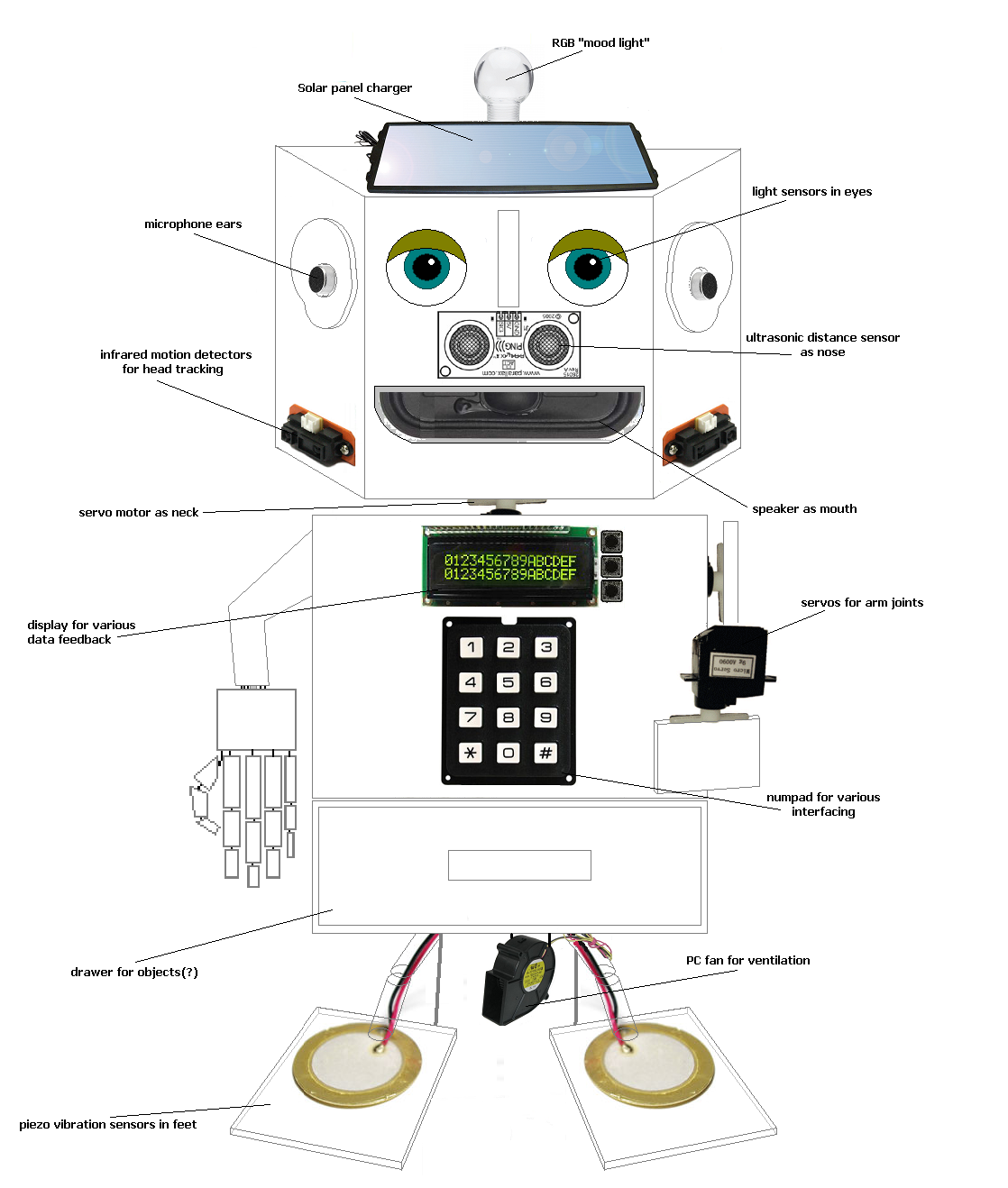
I want to show you a cute little side-project I am currently brewing on. It's going to be a robot with a
voice recognition shield for Arduino (EasyVR 2.0 Shield). The idea is to have a fully functioning voice controlled robot able to control power relays with motion tracking servo motors for the neck and arms.
Right now I am testing the voice recognition out with responds in both english and danish.


The final idea is shown in the drawing to the right. There will be a lot of challenges involved if I am going to realize all the ideas. I will need a little help from my friends.

lørdag den 7. februar 2015

DIEM Analog Synth Workshop 2015

Just a few shots from this weeks analog synth workshop with Henrik Munch on DIEM.


Henrik explaining the VCO
Random CV from  S/H module
The Roland System-100M
Close up of the System 100M
Syncing tempo with drum machine
The iconic TB-303
Moogerfoogers
Learning to use Oberheim Xpander
Jamming with the gear


onsdag den 28. januar 2015

Aristoteles Logic Synth Update #5: Sequencer

I couldn't hold myself back after finishing the AND-gate module for dear Aristoteles so I dug up the schematic I drew for the 10-step sequencer module and jumped right in. In the video below I'll demonstrate how it works and the possibilities are vast! Combined with the AND-gates it's very convenient for creating melodies and patterns.


The sequencer is based on the '4017 CMOS Decade Counter' which counts from 0 to 9; adding 1 every time a clock pulse is received on the CLK input. It has 10 outputs going high/low one at a time depending on the current count. Only one output at a time can be high; the one corresponding to the count.
There's a reset pin which decides when the counter will reset to 0 so it's possible to have it count to any number below 9. I've implemented a rotary switch for setting the count from 9 to 0. If the reset pin is set to ground, the count limit will be set to 9 (default).

If an audio range signal is sent to the clock pin and one listens to one of the outputs, you get harmonic intervals when reducing the count limit. This makes sense as it only takes half the time to count to 5 instead of 10.
The frequency ratio to the frequency we get when counting to 10 (which can be seen as our fundamental) can be calculated by dividing 10 with the desired count. So the relation between i.e. 10 and 5 (10/5) is 2. We multiply our fundamental with this number to calculate the interval, which in this case would be an octave.
The chart below shows the intervals we get when we're adding the value of the fundamental - which is what happens every time we add a step for the counter. Interesting stuff!


Multiple of
fundamental
Ratio
within octave
Common name Hz and chroma
(Example)
1x 1/1 Fundamental 110 (A2)
2x 2/1 Octave 220 (A3)
3x 3/2 Perfect Fifth 330 (E4)
4x 4/2 Octave 440 (A4)
5x 5/4 Major Third 550 (C5)
6x 6/4 Perfect Fifth 660 (E5)
7x 7/4 Harmonic Seventh 770 (G5)
8x 8/4 Octave 880 (A5)
9x 9/8 Major Second 990 (B5)
10x 10/8 Major Third 1100 (C6)


As is the custom, I've attached the scheme for the circuit for this module. It's not that intricate, just LED's and output jacks on each output. I see that I forgot to add the transistor LED-drivers, but it's just as usual - look in the schematics for the other Aristoteles modules to see how they should be wired.
I've used a 12 position rotary switch for the reset switch, I couldn't find any 10-pos so 2 of the positions are grounded which just sets the count limit to 9 (all 10 steps). It can be tricky to find out which pins correspond to the switch positions but easy enough when using a multimeter for testing continuity between the output and the desired pin.

I will post all my stripboard layouts in a single package when I am finished with the last module :-)

 UPDATE 7/2-15:

My brother and I (as the duo SNU) had a really nice jam with the Aristoteles modules so far.  Here's a video of  our session when the sequencer was still on breadboard. I had my Clock Box (which also runs on 40106 and 4040 oscillators) control the power for the 4017 so a lot of modulations back and forth.


fredag den 16. januar 2015

Aristoteles Logic Synth Update #4: Logic Gates

I thought it was time for building the next module for dear Aristoteles, my 'lo-fi logic synth project' so I did the logic gate module which consists of 8 AND gates with 2 inputs and an LED for the output. The truth table on the right describes how the gate will behave: the output only goes high (1) when both inputs are high. The result is a very simple form of amplitude modulation, or it can be used to control the path of signals from the other modules with counters or LFO's, you name it. 

The video below speaks for itself.


In the video I demonstrate the effect of the 3 different frequency ranges on the oscillators: LFO range signals are good for 'letting through' audio range signals at a certain rate for "beep beep beep beep" sounds. 2 audio range signals will generate complex pulsating modulations and beatings when adjusting the pulse width.
Setting the range to the high pitched setting on both oscillators will generate classic vintage radio-like modulation squeeks. I also tried using the 'octave divider module' for one of the inputs which has its own unique sound.

I chose to have all the logic gates as AND gates. For a long time I was in doubt about wether to have a pair of XOR or NAND gates just for the hell of it but I could not find a good reason as they don't do much sound-wise where as the AND gate is so clear in its function and I want to be able to make complex signal paths with counters, dividers, random clocks and all eight oscs - all controlling each other through the gates. 
I am already starting on the 10-step counter 'cause I cannot wait to have each step 'open' a unique oscillator with different frequencies!

The circuit is very simple, I basically just wired the in- and outputs straight to the 4081 but attached 100K resistors on each pin to prevent static electricity from the end of the wires going into the chip when patching.
LED's are controlled by transistors as always to prevent voltage dropping on the outputs.


UPDATE:
I had my brother a.k.a. SNU over and he fell in love with the new module which resulted in hours of wiggling.
Here's a a little peak of the tweak :-)

onsdag den 7. januar 2015

Terrestrial Signals III Live concert @ DIEM Elektro 'Pulse'

A late happy solstice to all of ye - I have been ind bed for most of the holidays, guess my body and mind was in need for some rest, it's hard work wanting to do you own thing and the following concert you are about to witness required a lot of planning and soldering.
I found out I was booked to play at the next of DIEM's obligatory student concerts 'DIEM Elektro' - this specific concert was called 'Pulse' so I prepared some pulsating light-controlled rhytms with a hacked monotron, using only the nice korg filter with a photoresistor, clock-synced to the notorious MicroWaveSampler by my Clock Box. I included my electromagnetic plasma ball synth described in the post below. I was pretty content with the outcome although some of my gear failed a bit, including my little TV-to-sound device. To much noise on the line to gain it. Anyways, please check out the video - it was shot by my brother Alec Sander and with his GoPro Hero camera attached to my head so you get the P.O.V. close up shots from my perspective. Enjoy!


I have a line of projects planned for this year, as I am writing my bachelor project which I think will focus on alternative media for releasing album material, more to come on that. After the last concert I finally chose to sucumb to the idea of a modular system instead of all these seperate modules which has to be wired together on set, it's too much hazzle every time I need to set up for a concert so now I will jump into building a complete modular system with the same principles used so far: analog means of sampling, tape delays and quirky little circuits. Stay tuned!

Lot of love, Dogenigt